2024 - Dunlap - Another strange year with record rainfall in May
and June (12" total!) after a dry, very little snow mild winter. The
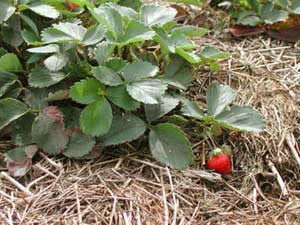
strawberries didn't mind that weather at all! We had great Dunlaps. Last picking
mid-July, and getting a bit of SWD by then. Set many runners to transplant to
rest of bed. I finally came to terms with having just one variety of strawberry,
and Dunlap is obviously our strawberry! It was time to stop fussing trying to
make other varieties fit our particular environment when they'd rather be
elsewhere. It's been a fun journey but I'm ready now to just have a good harvest
of strawberries - to eat, sauce, and dry.
Galletta - Newest section did OK but still a lot less berries than Dunlap, and
the previous year section was poorly with few berries at all. When harvest was
over I pulled all the plants, added compost, and in the fall set Dunlap runners,
filling up most of the bed (the rest will be filled in next year). Instead of
replacing one row (of four) every year I'll switch to replacing one quarter
section (of the 32 ft bed) each year. This will be easier to manage.
2023 - Dunlap - This year is Dunlap's 30th anniversary! I
received a handful of starts from Seed Savers Exchange members back in 1993, and
have kept it going since. This is really such a great berry and so appreciated.
This year it did great in spite of record heat and the long May-June drought.
Last picking mid-July. I set runners to extend another quarter to be half of
plot. Early Sept. transplanted rooted runner to new area, and removed oldest or
poorly plants-composted-set new runners. Thinned patch. Now are 16" apart (both
ways) and looking good. Plenty of runners.
Galletta - Wintered the mild weather well and set some fruit. Didn't
handle the heat and drought real well but going to keep it going, setting new
runners into old ONS space in the fall. It's a good berry for drying being
firmer and dryer than Dunlap.
Old North Sea - It did set a nice small crop of fruit in spite of heat
and drought, and appreciated. But it just is no longer thriving, nor has it been
for awhile. We've certainly gotten a lot of fruit from this special variety over
the almost 30 years I've had it, but it's time to let it go. Mid-July I pulled
all the plants, dug in compost, and in the fall extended Galletta into that
area. Farewell Old North Sea, you treated us well.
2022 - May had many low
temps/freezes so covered often. Later June brought first ripe berries, being eaten
by someone (robin highly suspected) so
put cage on. Appreciated small baskets of fresh fruit. Very dry July and SB suffered -
didn't think to water.
Dunlap - Very nice patch of plants and berries, started
picking 6/25. Still a few berries end of July. August rough (see above). Mid
July removed row2 plus any other poorly, transplant runners as available. Plan
to move Galletta to east end next year, replacing Valley Sunset, and expand
Dunlap into that area. Love this old variety!
Old North Sea - First small berries 6/21, a few good plants with healthy
larger berries. Pretty much done early July. Mid July removed row2 and other
poor plants (quite a few). Looking better. August rough but set some berries.
Galletta - Getting a few
large ripe berries 6/21. Slower to ripen than D and ONS. Berries good for
drying. Not as large a harvest as D and ONS but OK. Didn't handle hot dry July
at all well (my error for not watering), many dead leaves August. Let extra
runners set to move to east end.
Valley Sunset - First few ripe 7/4, some large. Trapped and moved a large
vole who was eating the berries. Slightly jucier than Galletta but many frit
rotting or misshapen. Just not thriving. End of July removed all plants, planted
buckwheat/oats. Move Galletta here next year.
2021 - Good Harvest Overall - In spite of another hot summer, with a challenging four night freeze in low to
upper 20's the end of May and drought conditions until the latter part of June,
it was a pretty good harvest. I think the heat, and maybe dry, shortened the
harvest season. I've gone back to removing one row each year (plus any poorly
plants), replacing with runners from adjacent row.
Dunlop was again the queen of the crop, from 6-25 to 7-10 I harvested a
lot of beautiful fruit. Old North Sea did OK, starting earlier than the
others, picking from 6-11 to 7-4. The fall crop was rough, likely due to the
heat. Valley Sunset are hanging in there with a moderate crop, first
picking 7-4 and about over after just a week. But overall the plants look a bit
rough and the harvest not up to par. Don't know if it was weather or disease
related. Hopefully will do better next year. Last year planted Galletta filled
in well, large plants needing about 14" spacing. Some blossoms froze in the end
of May freeze but we got a decent crop starting 6-20, medium-large fruit, nice
and sweet. Tall plants set fruit high. About done 7-4.
2019 - Variable Year - Well, every year is different and ever changing but some years push it a bit
more. After a record snow and unusually long winter a cool, wet spring hung
around into the end of June. Then it turned Hot! No gentle run-up this year. But
the well mulched strawberries handled it all quite well.
Dunlap was tops, with an excellent crop of the sweetest, juiciest berries,
larger than usual. It really appreciated the renovation last year. Ripe harvest
started July 8 and I picked a lot of berries the following week and half. Fresh
eating, fresh sauce, canned sauce, dried, mmmmmmm. It would have kept going but
SWD moved in. Those little fruit flies loved the fruit, too. So suddenly there
were a lot of mushy berries (thanks to SWD eggs/larva). So I went to the pattern
I've been using with the raspberries these past few years - pick every berry
every day - mush ones into a bucket of water, firm ones into the basket. But
after a few days I realized it wasn't worth it. I picked off all berries and
clusters. The patch had fed us well and I sure appreciated it.
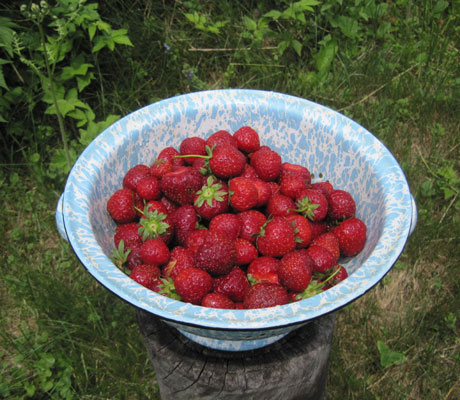
Old North Sea did well, coming in early as is its nature, first ripe June 23, a
very good harvest, healthy and delicious but, surprisingly, not very sweet. They
were also an unusual intense red. Wonder if there is any connection? But they
were still good berries and made a lot of good eating, mostly in sauce. They
were pretty much done by the time the Dunlaps started, and before the SWDs moved
in. Later berries were mostly removed with the Dunlaps (due to SWD) but a few
real late ones made it anyway for some surprise snacking in the fall. This is a
persistent variety!
The end of July one row was pulled, compost dug in, and new runners set from
nearby plants as they grew - both Dunlap and ONS patches. For several years
instead of the one-row-a-year renovation I tried just removing the oldest and
poorer berry plants throughout the patch. But I found it was easier to just do
one whole row (out of four) every year, plus any other particularly poor plants.
This works well for my "permanent" bed which has been going for almost 20 years.
Annapolis was again disappointing. The plants were healthy and the berries good,
very large and sweet - particularly good for drying. But the harvest sparse and
short lived. I think they are a good berry, but not for my garden. I have the
same trouble with Sparkle, a well thought of strawberry in our area and one I
like a lot. But I can't get a good crop more than the first few years. For some
reason neither variety likes to settle in long term, maybe it's hardiness, maybe
disease issues. Disappointing but at least others do well for me. I removed the
plants after harvest, added compost and planted oats/buckwheat as a green manure
crop. I plan to get a new variety for that spot next spring.
The newly planted Valley Sunset did well. A strong grower, generous with
runners, and it really wanted to set fruit, so I let about half do so, the
strongest plants. They ripened after Dunlap, large firm berries of the modern
type (not surprising since the variety was just released in 2009 from Nova
Scotia) and didn't seem much bothered by SWD. I particularly liked them for
slicing and drying. I hope they overwinter well.
Overall, a good strawberry year.
2018 -- Strawberries for the Dryer and for Sauce
 A
few years ago I planted a new variety in my strawberry bed, Annapolis, and this
year was the first real crop. It's doing well and surprised me with very large
fruit. I haven't been overly fond of the real large berries I've tried in the
past but Annapolis has decent flavor. And as a plus it's a firm berry so is easy
to slice for the dryer. It's also not overly juicy, unlike my other two
varieties (Old A
few years ago I planted a new variety in my strawberry bed, Annapolis, and this
year was the first real crop. It's doing well and surprised me with very large
fruit. I haven't been overly fond of the real large berries I've tried in the
past but Annapolis has decent flavor. And as a plus it's a firm berry so is easy
to slice for the dryer. It's also not overly juicy, unlike my other two
varieties (Old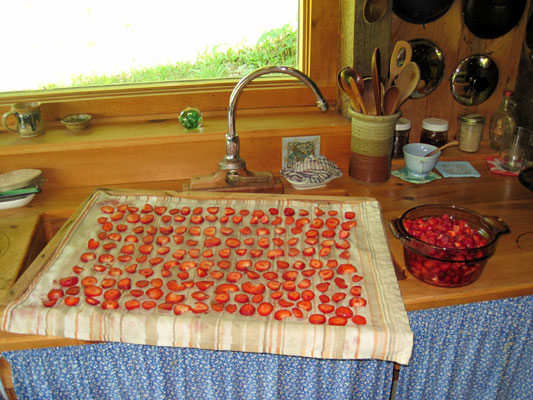 North Sea and Dunlap). I like having the Annapolis to dry and the
others for fresh (and canned) sauce. The berries are getting smaller as the
season progresses but still a good size. They're ripening during an abnormally
hot time so they may act different in a more normal (if there is such a thing!)
cooler year. The season may be short because of the heat but so far the plants
are producing well and we
thoroughly them. North Sea and Dunlap). I like having the Annapolis to dry and the
others for fresh (and canned) sauce. The berries are getting smaller as the
season progresses but still a good size. They're ripening during an abnormally
hot time so they may act different in a more normal (if there is such a thing!)
cooler year. The season may be short because of the heat but so far the plants
are producing well and we
thoroughly them.
The last two years I seriously renovated the Dunlap patch by removing ALL poorly
plants, leaving a rather small contingent to repopulate the area. This is always
a bit worrisome knowing I can't just go out and buy new plants if it doesn't
work. The same is true for the Old North Sea. Both patches started about 25
years ago with a small sample from Seed Saver Exchange members; I've been
growing and enjoying them in my garden since. The Dunlaps responded happily with
the best harvest I've had in many years. They have wonderfully tasting sweet,
soft fruit that pulls off the hull when fully ripe when picking. For the home
grower this is great (easy to go straight into your mouth!) but it wouldn't do
for commercial growers which is likely a big reason this variety is no longer
available.
2017 -- Once More Strawberries - in October
Many
years ago, maybe twenty, I got some strawberry plants from a Seed Savers
Exchange member that they called "Old North Sea". It was an old variety, grows
close to the ground with its fruit low, safer from birds and cold. A real nice
sweet everbearer of variable size it's been my main variety all these years. The
summer crop was light this year, but much appreciated. With the constant rain
from spring into September many plants had 'humidity challenges'. With the
strawberries it was leaf spot and the ONS plants looked the worse for wear in
that area. So I didn't expect much if any of a fall crop.
But as so often happens, I don't give growing things enough
credit for their ability to take care of things on their own. In later August I
noticed some very nice ripe strawberries. And about every week since I was
picking a small basket of some of the nicest fruit of the season! Every time I'd
think that would probably be the last; I'd eat some fresh, cook the rest and mix
it with the applesauce we have every morning for breakfast (with oatmeal) and
we'd appreciate anew the added flavor of the strawberries. Then another week and
there they would be -- more ripe berries. The harvest is getting smaller but the
appreciation is getting larger! And I think we'll be getting a few more in spite
of some very cold freezing nights. This is truly a hardy soul of the old north
sea.
The articles below first appeared in "Countryside Magazine"
in years past. For a more current discussion and info
check out my
"Growing Berries for Food and
Fun" book which includes strawberries, raspberries, blueberries and grapes,
published in 2016. More recent updates are included on this page above.
Happy browsing!
VARIETIES
 There is no one "right" variety. Taste, color, shape, size preference
-- all are an individual choice. Climate and your soil and ecosystem certainly
enter into the picture, as does availability. It does no good to yearn to grow
Fairfax, if no Fairfax plants are to be found. All the descriptive hype
notwithstanding, you won’t know how a strawberry does in your garden and how
you like it until you grow it, harvest it, and eat it yourself.
There is no one "right" variety. Taste, color, shape, size preference
-- all are an individual choice. Climate and your soil and ecosystem certainly
enter into the picture, as does availability. It does no good to yearn to grow
Fairfax, if no Fairfax plants are to be found. All the descriptive hype
notwithstanding, you won’t know how a strawberry does in your garden and how
you like it until you grow it, harvest it, and eat it yourself.
Although
flavor is, for me, a big factor in what varieties I choose to grow, their
growing habits are also important. Are they prolific producers of runners; or
are they less "outgoing"? Many of the newer varieties are bred for
large growers who manage their plots entirely by machine, and size is often
emphasized over flavor. Does that suit what you want? Sadly, these are usually
the only varieties available at the local nurseries, and you’re lucky if your
choice is more than one. If you have a source that offers a larger selection,
treat them well! Do support your local growers, plants grown near to your region
have an easier time with transplanting. But look wider if need be.
Most
varieties put forth their fruit within a particular time frame -- June in many
areas, July in my garden. Some are earlier, some later, so growing a number of
varieties spreads the harvest over a longer season, though there is much overlap
and each year is different. There are also the "everbearers" that will
produce a light crop in the spring, then another in late summer or fall. It may
be nice to have a small crop of berries later in the season, or it might just
not be worth the bother.
Some
varieties, such as Honeoye and Sparkle, are tall and produce their fruit high on
the plant, making them easy to pick and popular with commercial growers -- and
birds. Others, like Premier and Old North Sea, hug the ground, nestling their
berries low within the plant, keeping them safe from frosts and marauding
munchers. Others, Catskill and Dunlap in my garden, are in-between. They each
shine in different ways and in different years. Occasionally you’ll have a
year when every one puts forth with reckless abandon and you find yourself
scrambling to find new ways to make use of the fruit.
There
are also the perennial "Alpine" berries that you can grow from seed.
These bear a generous crop of delicious small berries throughout the season
starting the second year, and can be a fun option. Their manner of growth is
different than the others as they send out few runners and are usually
propagated by division of the crowns.
No
matter the variety, you will want to get your beds in shape first, truly weed
free and healthy with organic matter, the same as you do with most garden
vegetables. A few years of growing and turning in green manure crops can help.
Be sure to get those stubborn perennial plants out (such as grass and
dandelions) before planting. Once the strawberrys are established, those
"weeds" won’t be very easy to dig out without damaging the
strawberry plants.
MANAGEMENT
When choosing varieties, consider how you want to grow the plants. As always,
there are many options. If you use tiller or plow to manage your strawberry
patch, then the common mat system is probably what you will use. The plants are
allowed to set runners freely; the "mother" plants tilled under in the
fall and the "daughters" (runners) are left for next year’s
producing plants. Then their runners fill in the old space to produce the
next year’s crop, and the old daughter plants are tilled in. And so on, back
and forth. For this system, varieties that are prolific producers of runners are
best.
A
similar system is to grow the current year plants in a wide swath, letting
runners go where they want, then transplant the runners to another swath or bed
every year or two. The original plot is then tilled, plowed, or turned under,
continuing back and forth or around the garden. I do a version of this whenever
I move my strawberries, though with more runner control. Transplanting runners,
though easy, is a fair amount of work and not something I care to do regularly.
You can
also grow strawberries in pots and planters or special strawberry barrels if
your garden is an apartment balcony or a small patch between house and pavement
and neighbors. One fresh sun ripened strawberry is better than no fresh
strawberries, though the harvest is rather sparse given the work, and you may
find the limited space better utilized. The Alpine berries might be a good
choice for this type of mini-plot.
PERMANENT BED:
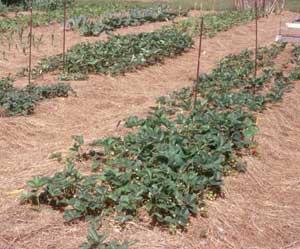 Since my strawberries are an integral part of my permanent bed garden, I’ve
come up with a different system that works for me. As is often the case, this
method isn’t "new" at all. Though I worked it out naturally for
myself, I have since read of similar plans in old gardening books. It is no
doubt common to many gardeners.
Since my strawberries are an integral part of my permanent bed garden, I’ve
come up with a different system that works for me. As is often the case, this
method isn’t "new" at all. Though I worked it out naturally for
myself, I have since read of similar plans in old gardening books. It is no
doubt common to many gardeners.
The
runner habits of a variety makes a difference in the amount of work involved in
maintaining my plot, and has a fair say in whether I like a variety or not.
Although I will give a good tasting strawberry much more tolerance and fuss than
a poor flavored one, I’ve come to appreciate those that aren’t so prolific
with their runner production. Thankfully, some of my favorite berries for flavor
are restrained in their runnery.
My beds
are approximately four feet wide and I maintain four rows of berries therein.
New plantings with purchased plants are usually established in the spring. If
you are using your own or a friend’s rooted runners then you might do this
later in the summer or early fall. If you have plenty of plants to start with,
simply fill up the bed with four rows, spacing plants 8" - 14" apart.
Some varieties will want more space (Sparkle and Honeoye), some less (Premier),
while others will be happy with 10" (Catskill and Dunlap), at least this is
so in my garden. But you can easily change spacing when you set new runners,
after you’ve seen how the varieties grow. If you haven’t enough plants for a
full bed, then put them only in every other row, or skip every other space in
the row, or leave two spaces between. It might take a year or two to fill the
bed, longer if the variety is a reluctant producer of runners, but it will
happen.
As the
plants grow and send out runners, move the best ones to the empty spaces. Run
them under the mulch and they will be more apt to stay where you place them,
pushing the little plant gently into the dirt. If you need to, you can make
simple holders out of pieces of coat hanger or other wire, bent in the shape of
a somewhat lopsided N. But be careful not to push the wire down so hard you
sever the runner stem. Most other runners are pulled off, leaving a few in case
they are needed later.
As
summer continues so does the fussbudgy part of growing strawberries in this
manner -- pulling off runners -- again, and again, and again. Prolific little
buggers they are, too, most of them. They WANT to multiply, and really aren’t
impressed by your arguments to the contrary. It is a constant but hardly a
difficult nor disagreeable chore. As you pull runners you can pull the stray
weed. When you are picking strawberries, you can pull runners. When you are
walking by you can reach down and pull of that errant little runner, hiding
among the mulch or enthusiastically heading across the path.
Now some
runners are particularly hefty and hardy guys so you have to take care not to
pull the mother plant out when jerking on the runner. You may decide to use a
pair of garden shears for some varieties, though a two handed approach generally
suffices. You don’t HAVE to continually pull runners. You can let them go
where they will, setting root where they choose and simply thin them all out at
the end of the season. But they do tend to crowd the place, and good air
circulation is cheap insurance against many diseases and unhappy plants. Pulling
runners off before they root, I’ve found, is easier.
Thus the
managed strawberry bed develops. Anytime you notice a poorly plant, pull it out
and replace it with a runner from a healthy, productive plant. Once the bed is
full you can begin regularly replacing old plants with new runners every year or
two: every other row, or every other plant in the row, or whatever system suits
you and your plants.
RENEWAL -- Decide which rows
will be pulled out -- let’s say the first and third rows. Pull runners off
these plants as usual. Even though you’ll be removing these plants later, if
you don’t pull the runners off now, they will put down roots here and there
and make the job more difficult. On rows two and four, leave a couple of good,
strong, healthy runners per plant, placing them where they are not in the way.
Usually if they are on top of the mulch they’ll grow their roots but not get
down to anchor in the dirt before you are ready to place them.
When the
harvest is over, pull the mulch back in rows one and three, then pull the plants
out. You can also dig them under with a shovel. I’ve done this, but it is
messier and makes it difficult to set the new runners well in the lumpy mounds.
Normally I discourage removing a plant or its roots from where it grew,
preferring to let it compost right where it is, but in this case it has worked
better for me to pull the plants out and deposit them in the compost heap. If
your garden soil and the plant is healthy, this will not be a casual flip of the
wrist. Strawberries develop very good root systems. But a trowel in one hand and
a good grip with the other usually works. If your soil is not up to snuff yet
and is hard packed, try a shovel or garden fork for assistance.
Smooth
and firm the soil back in the rows, maybe adding some compost if you have extra.
Then take a runner from each plant in rows two and four, run it under the mulch
and set it in the now vacant, adjacent row at whatever distance you’ve
determined would be best. Firm the little runner plant gently into the dirt, pin
if necessary and water. Then pull the mulch back around the plants and let them
settle in. You might water them a few more times if the weather doesn’t, but
generally there is not much else to do but let them be.
The next
year or two do the same thing but remove rows two and four. When you remove the
old plants, you can also remove those stubborn perennial weeds that become
established in spite of your best efforts. In this way you can maintain your
strawberry bed for a long time.
MOVING -- To move your bed,
let healthy runners set root in convenient spots between plants or along the
edges of the bed and let them root. If you set early runners, they can usually
be severed from the mother plant and dug and transplanted to the new bed that
fall. Or do it early spring. 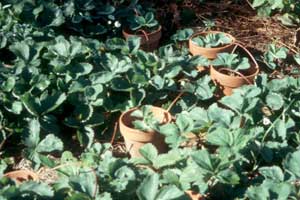
I’ve also set the runners into
small clay pots full of soil,
nestled in among the plants and mulch. It’s more work, but might make it
easier to move them a distance. Be sure to keep the pots watered if nature doesn’t,
they dry out easily.
If you
are going to ship rooted runners to someone (which you only want to do if you
have good, clean, disease-free plants) carefully pull the little plants from the
soil and pack them in a plastic bag. Don’t let the roots dry out. Moisten if
necessary but don’t sog them. Put the whole plant in, leaves and all. Send
them in a sturdy box, not an envelope where they could be crushed and smushed in
transit. Best to ship during a cool season, not during the heat of summer or
freeze of winter. Plant or heal-in received plants right away.
MULCH -- Most weeds will not
be a problem in the strawberry patch because of the generous layer of mulch you
are maintaining (you ARE mulching, aren’t you?). I prefer hay, weed-free of
course, and if possible loose, not baled. This won’t be an option for many,
but if you can get it, it is wonderfully nice to work with. When we cut hay for
mulch in the summer, I make sure I leave a good pile for late fall mulching of
the strawberry patch. Left under an apple tree, it does double duty of mulching
the apple tree meantime. In late fall, when the temperature is staying regularly
below freezing, I spread a generous blanket of mulch over the strawberries. If I’m
short of piled hay, then I pull some up from the paths to cover the plants. The
paths don’t need the protection over winter, but the strawberries might.
Most
winters our strawberries, and other perennials, get plenty of protection from
snow and don’t need the covering. But some years the cold comes but the snow
doesn't, the ground freezes deep, and many perennials and young trees have a
hard time of it, including little strawberry transplants. And this is sure to be
the year I transplant a lot of transplants into new garden beds in the fall and
am in a hurry and short of mulch to cover them adequately so ... . Oh well,
lesson learned. Now I always mulch the little critters.
In the
spring, when the plants underneath their protective covering start growing and
calling for sunshine, I pull the mulch off the tops and tuck it around and
between the plants. And that pretty much takes care of the weeding and the need
to water. If your soil is not well drained or doesn’t hold enough moisture
under the mulch for healthy plants, then work on your soil. Holding a hose over
the plot every week splattering cold water over the plants is a poor
alternative. And not particularly pleasant for the plants I would think. Trust
nature and the plants -- they really DO know how to do it.
PROBLEMS -- There are many
diseases and insects who live hand in hand with strawberries. If you have
healthy soil and give your bed adequate attention, particularly to keeping it
comfortably thinned, then you will probably not be troubled significantly with
any problem ( not counting the furred or feathered varieties). If you find one
kind of strawberry particularly susceptible to a blight or fungus in your area,
then grow a different variety. If a plant is doing poorly, then pull it out and
replace it with a healthy runner.
I have
had trouble with diseases and plants "running out" -- plants and
berries getting smaller and smaller and obviously not thriving. But it has only
been when I’ve neglected the patch and let it get crowded and overgrown. If
this happens, you can buy new plants and start a new bed, if you are going to be
able to give the strawberries the attention they need. Otherwise, it is an awful
lot of work for nothing. But if you have varieties no longer available
commercially, or don’t want to spend the money, you can renovate your patch
with what you have. I have done this several times with success, though I
certainly don’t recommend letting your plants get to this point in the first
place.
Choose a
new bed, free of weeds, with healthy, humus rich soil. Transplant the best
looking runners from your old bed, pinching off all but the best looking leaves.
Treat as you would any new strawberry bed, spacing generously, watering, caring
and mulching. As the plants grow, pull out those that are marginal and set
runners from the best ones. This is usually a several year process of selection,
so be patient and don’t reduce your planting to a bare skeleton. If your
plants truly are too far infected, then you’ll simply have to start over with
new plants. But if you succeed, you have a selection of plants that are
particularly resistant to whatever problem they had to begin with.
BIRDS -- For twenty years I’d
shared my strawberries with the various birds and small furred creatures that
live here, with no great problem. I’d come to appreciate the varieties that
hid their berries among the foliage instead of holding their berries up and out
for all to see -- and eat. I was the only overly greedy harvester. But life is
never static. Last year (2004) I was looking forward to one of our best
strawberry harvests ever. I had spent many years and untold hours renovating my
strawberry beds -- 65 feet of four rows of six varieties of healthy, producing
plants. Buds were set, fruit was forming, and on June 24, I picked the first
early, delicious berries from the small but wonderfully hardy and prolific Old
North Sea plants. A few days later I got a handful. Basketfuls would be ready
soon. At the other end of the bed, the more modern, large Honeoye were not far
behind. Though not my favorite for flavor, they do produce well and are early. I
could see the Catskill and Sparkle coloring up as well. Dunlap and Premier, I
knew, would be later.
The next
day I went out and, to my surprise there were no ripe berries to be picked.
Being busy, I shrugged and figured things had slowed down because of the weather
and went about my work. It took a few days, but it finally dawned on me that
there were not only no RIPE berries, there were NO berries with any color at
all. Whenever a strawberry developed a bit of red, it disappeared. Dumbfounded,
I stood in the garden trying to figure it out. We had two cats, we didn’t have
that many chipmunks and squirrels. The usual array of birds were living
their usual individual lives, maybe sampling a berry now and then, but certainly
not spending over-much time in the strawberry patch.
Then I
heard a chorus of short high musical tones -- coming from a flock of birds that
I had been enjoying recently as they played and flitted among the apple trees,
as only Cedar Waxwings can do. We’d always had a few in the fall, and maybe a
few in the spring when the apples were in blossom, but never a resident flock in
July. I smiled in pleasant recognition, which turned to amazement, then
laughter, as they ignored me and made beelines to the strawberry patch.
Certainly no mystery any longer! But what to do about it? I chased them away and
realized the solution had to be fast if we were to have any strawberries at all.
I didn’t mind sharing, but I wasn’t THAT generous.
Nylon
netting was out of the question, I simply didn’t want it in my garden. So I
enlisted Steve’s inventive self and we soon came up with a plan. We dropped
all else and went to work. He scrounged up some 3/8" rebar and headed off
to the shop and his torch. I made some phone calls then took off for town to buy
several rolls of chicken wire.
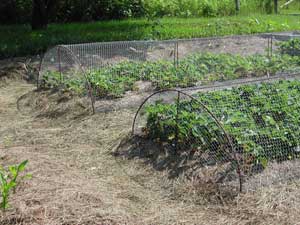 Back home, Steve cut and bent half loops of the rebar for
the ends of the beds, and I folded fencing over them. Long rebar
"staples" were placed down the middle of the rows, to stand about two
feet above the bed. I cut the 4 foot wide fence into 7 foot lengths, folded the
cut ends into a "hem" to make them easier and more comfortable to
manage. Then we draped the fencing over the bed, edge to edge, held up by the
rebar staples in the middle and resting on the mulch on the edge of the beds.
Back home, Steve cut and bent half loops of the rebar for
the ends of the beds, and I folded fencing over them. Long rebar
"staples" were placed down the middle of the rows, to stand about two
feet above the bed. I cut the 4 foot wide fence into 7 foot lengths, folded the
cut ends into a "hem" to make them easier and more comfortable to
manage. Then we draped the fencing over the bed, edge to edge, held up by the
rebar staples in the middle and resting on the mulch on the edge of the beds.
Finally, the strawberries were covered and secure. We went in to dinner. Then I came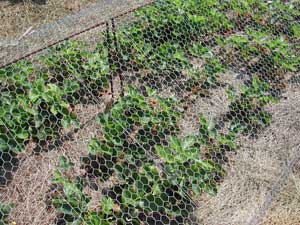 back out to find a lone Cedar Waxwing inside the cage,
unhappily trying to get out. I released him, then rounded up a batch of clip
clothespins to pin the edges of the chicken wire pieces together. That was the
last bird we had in the strawberry patch until the cover was removed. back out to find a lone Cedar Waxwing inside the cage,
unhappily trying to get out. I released him, then rounded up a batch of clip
clothespins to pin the edges of the chicken wire pieces together. That was the
last bird we had in the strawberry patch until the cover was removed.
| To work
in the bed or pick strawberries, I simply unclip the clothespins and gently fold
the fencing back. It wants to slip off over the other side, but a few wire ties
at the top hold it in place. When put back down, one has to pull up a bit in the
center to bend it back in shape, then reclip the edges. The shorter plants have
plenty of room within, but the outer rows of the larger plants do crowd the
fencing a bit and any berry within reach is fair game for the birds, which is
only fair.
We ended
up with a great harvest, and though certainly not as easy as an uncovered bed,
the chicken wire cage worked quite well. Except that, in addition to keeping the
birds out, it also keeps the gardener from easily nipping a berry when wandering
by. Sigh.
When the bulk of the harvest was
over, I removed the loops of fencing, rolled and secured with a rope and stored
for next year. The birds happily, and immediately, came in to finish off the
last of the berries. So, in the end, we all enjoyed a very good strawberry year.
[see
"Growing Berries
for Food and Fun" for our later, and easier to manage, bird barrier cage.
Published in 2016 it has additional info from my additional years of experience
growing strawberries, as well as raspberries, blueberries, and grapes].
SOURCES -- Unfortunately, I
know of few sources for the older varieties of strawberries now that Walter K.
Morss of Massachusetts has retired from the business. If you are interested in
other than the usual "modern" commercial varieties, ask around, maybe
there is someone in your area growing one or two, and who might be willing to
share a few runners with you. The internet should make it easier now to find
varieties and sources so do some searching. Though, as I mentioned, I recommend
getting plants grown as close to your home as possible.
FEDCO Trees, PO Box 520, Waterville
ME 04903-0520, does carry some varieties and will hopefully carry more as they
come up with other sources (they used to handle Walter Morss's berries). Check their listings on their website at www.fedcoseeds.com.
They often list different varieties different years, and have good descriptions
and a very good philosophy.
* * * *
*
2008
Trials and
Changes: More varieties planted, and more dropped in the last seven years.
Catskill because, as interesting an old variety as it is, it never thrived. Plus
the berries went from barely ripe to mushy overnight it seemed, though the
flavor wasn't bad. Sparkle because it "ran out" after only two years,
as it has done for me before. It's a great berry and I like it, but apparently
my garden and conditions are not to its liking which is too bad. Honeoye finally
came out this year as I admitted that though large and beautiful and productive
a berry, it was just plain flavorless. I'd diligently search all over the Old
North Sea plot for just one more little luscious jewel to eat before I'd give up
and pick some easy Honeoye's. But only for sauce, never to go on the table for
fresh eating. All looks, no flavor. Plus it was way too prolific in runner
production. Nice strong large plants though. Premier never made much of a crop
for me and those that came were slow ripening, soft, and insipid tasting. So I
replaced it with some Earliglow from a local grower. Lesson learned here: it's a
great idea to buy your plants locally IF the grower does a good job and IF the
plants are healthy and hearty. These weren't, and they didn't get any better.
Prolific runners and hardly any berries. I'd grown Earliglow before so knew it
was an OK berry, but these just couldn't get past their poor beginnings. Sigh.
Enough experimenting, time
to simplify and settle in. When the clean-up was done after the harvest was over
I was left with my two favorite varieties: Dunlap and Old North Sea. I'm happy
with that.
But it has been fun, and
many, many nice harvests of delicious berries have been harvested and eaten. My
system of renewing one row of the four each year has worked well (plus taking
out any other plants that aren't thriving). The plants continue to do well in
the patch that was started the fall of 2001. The yearly hay mulch continues to
keep the soil rich and moist (even in the drought years) and helps immensely in
keeping the weeds out. It's not been that hard to keep those that root pulled
and the runners thinned. And the more comfortable the strawberries are, the more
I enjoy spending time with them. It's amazing how nice a crop you can get if you
give it a reasonable amount of attention and care. And let them do what they do
best.
* * * * *
2004
The wild
strawberries, on the other hand, don’t care what I do as long as I leave their
turf alone. They produce, or not, and I can harvest or not. But I partake of
their riches only here and there. To harvest a whole bowl-full seems too greedy,
and negates some of the magic of the tiny fruit. At least that is my excuse for
growing tame strawberries instead of simply picking what is so generously and
openly offered in the wild. I rationalize that the other creatures need them
more than I do. The "it takes too much time to pick wild strawberries"
excuse seems pretty lame when I consider the time I spend on my garden patch.
But for
those who love and grow strawberries, rationality has no reason anyway. One just
does. I currently have six varieties and have tried many others over the years.
One variety could do, but if you truly want strawberries, it is hardly adequate.
Strawberries
are generally considered a northern fruit, though they also dip into the warmer
climates. Plants and buds can be susceptible to winter freeze damage, although
mulch and snow give them needed protection. The various strawberry varieties
have their preferences for soil type and texture. But it does no good to say
that the preferred soil is "this", if all you have is
"that". If you have soil that grows green things, then you have a good
chance of growing strawberries.
Strawberries
like sun and dislike overly dry or overly wet. I get a better harvest when my
beds are farther away from the woods, where the squirrels and chipmunks thrive
and sallie out nearby to dine. A reasonable amount of observation and attention
will tell you more than any text what your strawberries prefer in your land.
But, as with most plants and animals, people included, strawberries grow best
where they grow naturally.
* * * * *
2001
Strawberries didn’t do well this year, but I can’t blame it on the weather. I had
ignored them the year before and they were all too thick. Finally in July and
August I got in there and thinned vigorously. I set runners into small clay pots
set in the bed to start new plots. Though this works well, I’ve decided it is
much easier to just dig up the naturally rooted runners and transplant directly
and not go to the trouble of potting them. They do as well, or better, and you
don’t have to worry about getting them planted before they get too root bound
in the pots.
I decided to drop a few of the varieties I’ve been growing. Fort Laramie
because of its blah flavor, although it does produce nice large berries and has
done well. But I prefer flavor. Goosecap is another vigorous berry that produces a
nice crop but it is too enthusiastic. It’s hard to keep up with thinning the
runners. It would be a nice variety for those who manage their crop by tilling, but for
my permanent bed, it’s just too much trouble. Lenore is an alpine that I got
through the Seed Savers Exchange. A nice tasty berry, it is of the usual small
alpine size and I found I often just don’t bother to pick it. So I shall let
it go as well.
In the fall after the peas were harvested (because that spot was where I
wanted one of the new beds) I transplanted the little pots of runners of Dunlap,
one of my favorite strawberries for flavor. Then I transplanted Old North Sea
among the pepper plants, as the peppers weren’t done yet. In the spring I
shall buy a couple of new varieties as well. I set them all in four rows, 20
inches apart, and will let the plants set one runner between, so they will end
up about 10 inches apart. I’ve found this to be a good distance for growth and
air circulation and to mulch. By managing the runners (when I DO it!) I can
keep a good bed going for many years. But eventually the perennial weeds
(particularly grass and dandelions) get a hold and it’s easier to move the bed
to a clean plot. Maybe I'll do better in the future.
REMOVING MULCH FROM STRAWBERRY PLANTS -- I
had covered my strawberry plants to protect them this winter; when am I supposed
to uncover them? --Debbie
I uncover mine when they start looking like they want to grow in the spring,
gently pulling off and tucking the mulch around the plants. But since we often
get late freezes I'm prepared to cover them back up (with mulch or blankets) if
the temps suddenly drop into the teens or 20s. It depends on the variety, but
most can handle cool temperatures just fine. A really cold one might damage buds
though. Mostly I don't fuss too much with them and I always get berries, but the
varieties I grow put their berries low on the plant where they are more
protected.
CATSKILL STRAWBERRIES -- I'm interested in
planting Catskill strawberries which seem to be a vanishing variety. Our family
legend -- I don't know if we can verify or disprove it -- is that my
grandfather, Fred A. Smith, participated in the creation of this variety at the
Geneva Experiment Station in the late 1920's. Grandfather was superintendent of
the Essex County School of Agriculture in Massachusetts and a graduate (1894) of
the Massachusetts College of Agriculture, now known as UMass. Tim Nourse used to
sell Catskill plants, but I can't find them in his catalog or any others. I
notice that you have grown them recently and wonder where you find the plants.
--Bob from Maine
How interesting! Unfortunately, my source was Morss & Sons, Mass. who retired in
2005 and that was the only source for the older varieties that I know of. He
sent me to Fedco but they, I think , are also looking for a new source for
plants. Hopefully they will come up with someone in the future. I would offer
you runners, but my plants are not disease free and aren't really thriving.
[I later gave up on them as they never did do well].
STRAWBERRY BLOSSOMS -- I have had a
strawberry patch for 4 years now and I am still learning it. Can I use the
runners this summer to produce berries for next summer? Or do the runners this
year make for a better crop in 2 years from now? -Jim
It depends -- if the plants are smallish I
generally pick the blossoms off and don't let them set fruit the first year, if
they're larger and hardy looking I let them go ahead and produce berries.
Sometimes if I'm busy I don't do anything at all, just let them fruit when they
feel like it. It all seems to work out OK.
|




 .
.