|
Itasca '21 //
Bluebell '04
//
P.S. seedling '18 // Somerset Seedless '17 // new green
// Prairie Star '13
(former vines now
removed - Valiant, King of the North, Marquette, Brianna)
2022 - Not Giving Up
The "abnormal" weather is now the norm,
extremes common, we might as well admit it. The plants and I are just taking
it as it comes and doing the best we can. Grapes continue to be a challenge
here but we're not giving up. There was a lot of covering, uncovering,
covering of the vines in spring. But with the new system of putting the
vines on the ground over winter it was much easier to cover with blankets
and tarps. With buds swelling and breaking, even leaves, the teens and 20's
frosts and freezes through April and May kept me busy. Because of the harder
pruning last fall (to change over to new system) there weren't a lot of buds
but most of the vines did well with good summer growth.
Itasca winterkilled top 6" but did have low buds
growing. Unfortunately early to start but it grew well with canes to 1st,
2nd and 3rd wire.
Bluebell grew vigorously, had to summer prune.
Small harvest, colored but not ripe when Sept. 22 freeze. Picked anyway.
Prairie Star Seedling did wonderful. First fruit!
Four little clusters. Nice, small, white/light gold color (like mother)
grapes - sweeter and ripened before Prairie Star mother vine. Little but
tastes like "store" grapes! And even better, no leaf issues.
Somerset Seedless - early to grow, had 20 fruit
clusters this year. Had good growth, first to ripen. Picked when tasted
sweet and well colored but when I juiced them the result was Blah! I'm
thinking they just weren't ripe (I hope!). They do color well before being
fully ripe and I was just too impatient. Nice sweet flavor fresh though and
I snacked on them a lot. Small size, similar to Prairie Star Seedling,
smaller than Prairie Star.
Unknown green - a friend in Sault Ste Marie has a
nice green grape growing that was growing when they moved there. He said it
is sweet, seeded, somewhat late. He sent me rooted cuttings, two, with good
roots and buds opening May 16. I planted one here and one in the NEOrchard
(that one didn't survive). Grew well, healthy.
Prairie Star - this one was a mixture of old and
new as last fall there wasn't a really good new cane to overwinter. Some
winterkill and leaf issues, some black rot spots. But overall grew well.
Latest of all to bud. But not fully ripe when picked Sept. 22. [I picked all
when freeze forecast because there wasn't enough of a harvest to warrant
covering, which would have meant the very large tarp over the entire setup.
October 24 I pruned all to 2 best, strongest
canes. Only Bluebell and Prairie Star (the oldsters of the bunch) had
laterals. Pruned them to 3 buds. Laid all down. Thankfully did get some snow
cover before too long though it has been a sparse snow year thus far
(January).
2021 - Dry Winter, Dry Spring, Hot Summer
I had read about the new hardy Itasca grape and it sounded worth trying. So
when I removed Brianna I decided to plant an Itasca, but the only place I could
find a vine was from Jung's. Not the best but I ordered it anyway. It arrived
half out of an open plastic bag with a scant handful of damp stuff in the bottom
of the bag. It looked dry and dead but I set it to soak and hoped for the best
(and resolved to be patient and only buy from reliable sources!). I gave it good
care and it did survive and grow.
With the dry winter and early warm-up everything started early, including the
grapes. When a 22 deg. freeze hit in late May there was a lot of bud kill though
I had covered the vines with blankets. More freezes forecast (ended up four
nights in a row) so we got out the big tarp to cover (which I should have done
to begin with). That helped but the damage was already done. They did regrow and
there was a light harvest in the fall. With the long hot summer and late fall
frost what managed to survive matured well. Harvested 2 1/2# from Bluebell and 3
1/3# from Prairie Star for over 4 pints of good strong juice. I enjoyed the few
small bunches of Somerset direct from the vine.
New Plan -- In looking for vines I came across an excellent article on
Canadian "Hardy Fruit Tree Nursery" site, whose website I'd been to many times,
sighing over the truly hardy offerings there that aren't available to us here in
the States. This article was "How to Prune a Grape Vine". I'd read so much over
the years on this subject, all pretty much the same advise, that I almost
skipped this. But being determined to find a way to grow and mature grapes here
I gave it a read. This one was different. This was from folks who truly
understand trying to grow fruit in the north. And the video was excellent.
After all these years of going back and forth trying to put my vines into the
permanent trunk Fan or Kniffen method box I completely changed direction and in
the fall pruned to the "Hardy Fruit Tree" way. Now, laying down vines for winter
certainly isn't a new concept but their method is different from anything I'd
read. I'm feeling more hopeful about my grapes! I had a good current cane to
prune and lie down on all but Prairie Star.
Unfortunately, when I went to the Hardy Fruit Tree website to get (and post) the
link to that article there was a note that it would be coming "soon" as they add
info to their new website. So check their site later for the article. But
meantime here is a link to the YouTube Video:
https://www.youtube.com/watch?v=5jmY6KPBOJc
2020 - They Keep Trying
This year’s grape harvest certainly doesn’t have
bragging rights, hardly worth mentioning in fact. Lot of winterkill, so
early on figured they were a bust (lesson learned - never underestimate your
plants!). But to my surprise, late but significant, a good number of buds
grew. Hope! Then the first May freezes (teens-20’s) hit. Oh well, maybe next
year. But they felt different. Secondary buds grew! Scattered throughout the
vines but enough. When the second hard freezes came (we had record cold May)
I decided to cover. But when I was done covering the garden the second night
I forgot the grapes. Obviously lost again. Darn! And considering the record
heat this summer it could have been a decent ripe. But the vines didn’t give
up - thirdiary buds grew and these never-give-up vines set a small crop.
These late comers did their best but just not enough time. When an early
hard freeze was forecast mid-September (it got down to 21 deg) I decided
there weren’t enough near ripe to cover so I harvested what I could find.
Picked out the ripest grapes and juiced with plenty of sugar and some
apples. Got 4 1/2 pints which was OK for such a rough year.
Marquette was the winner with the most ripe and near
ripe berries. It thankfully has recovered from the vole damage a few winters
ago. Sommerset tied with Marquette. I’m SO thankful to Jesse and others who
recommended this variety. It is low vigor and small vine but the grapes
sweeten early. I ate all the ripe ones off the vine but still had some for
the pot. I’m going to plant another Sommerset.
Prairie Star was close and is still a keeper for me
even though I didn’t get much. It came through the difficult winter in good
shape. Bluebell just had a handful of barely ripe but I still think its
worth it for the good years. Brianna is coming out this fall. It was with
Bluebell with very few even close but mainly it is just too vigorous for my
spot and my vine continues with some leaf issues. In a warmer location I’d
still recommend those two though, both for berry size and flavor.
So, not a great or even a good grape year but it did
give me a better appreciation for the vine’s persistence and desire to grow
and produce. And a resolve to cover, cover, cover, and give them a chance.
On to next year!
2019 - Rough Winter, Short Summer, Wet Fall - But
They Made It!
When I pondered the large amount of winterkill on the vines I figured it
would be sparse crop come fall. Grapes just have a rough time of it here. It was
a very cold winter, record snow, slow spring with a 24 deg freeze early June to
take out some early growing buds. Dieback was both high and low, surviving buds
scattered, so I pruned to my all too usual style -- cut off dead wood, count
buds wherever they are, if more than 40 prune back to that number, going for
some semblance of order with canes that are left. I tie them to the wires in a
somewhat two wire Four Arm Kniffen System. Sometimes they even come out looking
somewhat like that. They don't really care, nor do I, as long as what I do
doesn't interfere with their desire to set and mature fruit. A desire I applaud!
They all grew well, most needing late summer pruning to tame the jungle. And in
the end the total harvest (October 14) was equal to last year's, even without
the previously prolific King of the North which I had dug out last fall. I love
those kind of surprises, and thoroughly enjoy the juice. We had a very good
apple year this year so made a good supply of cider - my favorite to mix the
somewhat strong grape juice with.
Brianna, only two years in the ground, did not fare winter well, losing about
3/4 of the vine, leaving only about 16 buds. Being young this was OK since it
shouldn't be fruiting much yet anyway. It is a vigorous grower needing extra
pruning to keep it in check. Unfortunately, it again had some leaf issues so
along with its over vigorous habit I'm not sure I'll be able to keep it. But I
let it set a half dozen bunches and they were very good, a pretty golden color,
sweet. I'm not giving up on it yet.
Bluebell
(MN 158 (Beta x unknown)
Developed by JM Dorsey, U Minn, 1944)
came through best of all with the lightest winterkill and plenty left.
Unfortunately, it was a little too eager and lost many growing buds with the
early June freeze. But it grew well and I was able to prune it to a good shape.
The generous crop barely made it to ripe (most being from secondary post-freeze
buds) for its largest harvest yet of 15#. In a little warmer climate this
variety would be top notch, but even here it does a commendable job.
Marquette sadly was mostly winterkilled. In spite of being promoted as a great
northern midwest wine variety I'm afraid it isn't living up to that PR. A local
winery who has a large field of Marquette in a better location than mine is
having large winterkill problems, too. Bummer as it's a very good grape! But
it's a vigorous grower and recovered well over summer. Maybe that is its problem
though, the vigorous growth isn't hardening off well. Same with Brianna. I keep
hoping they will both adjust to this climate. I will give Marquette another
winter and see how it does.
Prairie Star
(TP 2-1-24 (MN 1094 x ES 4-7-26) Tom Plocher intro, 2010)
had a lot of winterkill, too, about 1/4 - 1/3, but had enough left
for 40 buds. It had its most vigorous growth this year (planted in 2013) and set
a good crop, its best thus far at 7# and they were ripe! It's a very nice white
variety, gentle and sweet.
Last fall I had replaced the King of the North with a Prairie Star seedling. The
top winterkilled (sigh) but 5 low and new shoots grew well and healthy, almost
making it to the bottom wire. Sure be nice if it surprised me by making it
through the winter in good shape! I'm anxious for it to grow and fruit and see
what kind of fruit it has, since I don't know which grape pollinated it. Plants
from seed are slow but so much anticipation and fun.
Somerset Red Seedless
(ES12-7-98 (ES5-3-64 x Petite Jewel)
Swenson intro.)- A success! Even if it was only one very small bunch of 5
berries. And even if the small young vine winterkilled except for one low bud
(many more grew from the roots). But it grew well, was very healthy, had no leaf
issues, made it to the top wire by the end of summer. And most important, those
little grapes were the first to color up and the first to ripen! Even better,
they were sweet early on, before being fully ripe. Though small they lived up to
their reputation as a really nice grape. I'd gotten more recommendations from
others to grow Somerset than any other variety. This grape shows great promise
and I do hope it develops better hardiness as it gets older (it was only planted
2 yrs ago.
2018 - Wonderfully Long, Hot Summer
We don't get ripening summers like this one very often but relish it when it
happens. I sampled many berries on the vine and thankfully the birds, for the
most part, were busy eating elsewhere. Unfortunately, the winter wasn't as kind,
with sudden deep temperature drop in December, record cold April
into sudden record high May, and little snow throughout the winter. Then there
were the voles... But in spite of a lot of winter-kill on all vines and
plentiful vole damage we ended up with a total of 24# harvest of well ripened
berries, and lots of tasty grape juice.
The newest two vines regrew well from
their winter trials, Somerset Red from being eaten by voles and Brianna from
winter kill, likely because it was a young vine. But Brianna managed to set a
tiny bunch of several berries so I could taste them - delicious! Medium-large,
golden white, sweet. It's a very vigorous vine and, unfortunately, had quite a
bit of leaf issues. Hopefully it will settle down once it is better established.
Somerset is a much less aggressive vine with little to no leaf problems. I'm
really looking forward to a harvest from this one in a few years. I did put
hardware cloth around all of the grapes before winter set in to prevent a
recurrence of the vole damage (first time I'd ever had them eating the grape
vines! But it was a record vole year.)
Both Marquette and Prairie Star had a lot of winterkill which surprised me, so
harvest was light, especially with Marquette. Both grew well through the season,
though, with Prairie Star finally catching up with the
other vines for size. The PS fruit bunches were particularly nice and full, and
delicious. I sampled this one a lot!
Bluebell was a disappointment just because of the extent of winterkill, which
meant a smaller harvest in a year that was finally long enough and warm enough
for the fruit to mature well! But it did its best with the
vines and buds that made it through the
winter to put out over 8# of really nice, ripe fruit. What fruit I didn't eat
fresh made great juice. It is such a nice grape that it is worth growing it even
those years it doesn't quite mature.
King of the North was the only vine that didn't have much winter-kill, nor any
vole damage. It did have a good crop, with
a harvest over 13#. But... It is a VERY vigorous vine, wanting to take over the
entire grape trellis I think. Trying to keep it pruned back is an all-summer
job. It doesn't mature very well, even this exceptional year, and is the least
sweet of my grapes. Plus it had some black-rot this year which, since I don't
spray, is something I definitely want to keep out of my small vineyard. So,
though it is the most prolific of the vines, I finally decided to take it out
after harvest, while appreciating the good fruit it gave me this year and
previous years. In its place I planted a Prairie Star seedling I had growing in
the nursery. I had planted the seed the fall of 2016 and it grew well and
healthy, being about waist high. It will be fun to see how it does and what the
fruit is like. As it was open-pollinated I don't know who the father is.
2017 - Respectable Harvest
 With
such a rainy summer and many frosts in September I wasn't sure we'd get ripe
grapes this year. But by covering the vines with a very large tarp when the cold
snaps hit to keep them from freezing they managed a respectable maturity and
crop after all. Since it appears the cold/cool weather will continue, along with
more rain, I harvested them today, October 1, and was happy with the yields. This is their
second year of fruiting in this new spot and it appears they are much happier
here with more sun, better air circulation, and slightly higher ground. I ended
up with 20 pints of grape juice which is pretty good from 4 young vines. With
such a rainy summer and many frosts in September I wasn't sure we'd get ripe
grapes this year. But by covering the vines with a very large tarp when the cold
snaps hit to keep them from freezing they managed a respectable maturity and
crop after all. Since it appears the cold/cool weather will continue, along with
more rain, I harvested them today, October 1, and was happy with the yields. This is their
second year of fruiting in this new spot and it appears they are much happier
here with more sun, better air circulation, and slightly higher ground. I ended
up with 20 pints of grape juice which is pretty good from 4 young vines.
The grapes were healthy and beautiful. They are fun to harvest, one bunch at
a time, cutting them off and laying them carefully, and admiringly, in the
basket. Popping one or two in my mouth now and then. But two things were
missing this year. One was the aroma of ripe grapes. It's quite distinctive
and something I was used to when I harvest. But it wasn't there. Maybe
because the grapes were just barely ripe, no overripe or split berries.
Maybe it was the weather, cool and damp as it has been. And along with that
there were no yellow jackets. Usually, I'm very conscious of their presence,
carefully putting my hand on a grape cluster to make sure I don't
inadvertently handle a yellow jacket along with the grapes. Now I admit it
was easier that they were missing but it was disconcerting and I'd rather
have them there. They love grapes as much as I do. But we've had very few
wasps/hornets around this year. I missed them, and certainly hope it's a
temporary situation.
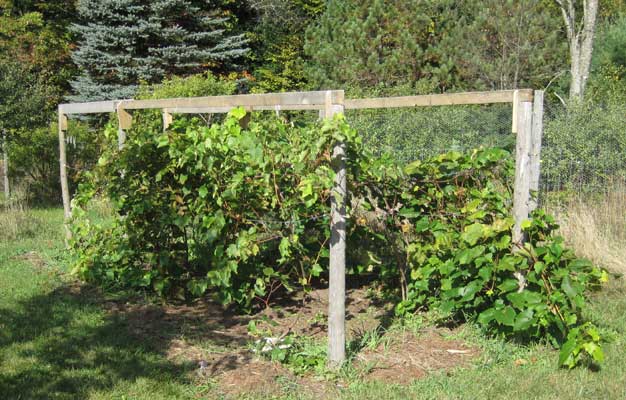 I have four vines fruiting and two more just planted this year. That is all
I have room for in this space and that really is plenty of grapes for us.
But it's hard not to keep looking for new varieties to try! I guess it helps
that there are so few grapes that will mature in our climate. I have four vines fruiting and two more just planted this year. That is all
I have room for in this space and that really is plenty of grapes for us.
But it's hard not to keep looking for new varieties to try! I guess it helps
that there are so few grapes that will mature in our climate.
Bluebell - is the largest and sweetest of the current crowd, when it
matures, which it barely did this year. But it is such a great grape when we
do have that rare long, hot (relatively speaking) season that I keep the
vine and it keeps doing it's best. It is the closest I have to an 'fresh
eating' grape and I sample it regularly as soon as it colors up, waiting for
it to sweeten up as well. It didn't quite make it to peak ripeness this year
but it came close. And at 10# was the top producer and made decent juice.
King of the North - is a grape I've grown for quite awhile, transplanting it
from the old plot where it had a hard time ripening. It is very vigorous! I
had to really keep on top of it with summer pruning to keep it in its
allotted space. I'm sure it would prefer to have more wire to itself but
this grower prefers to have more varieties so they each have to make do with
less. Actually, I had planned to dig this one out after harvest. It's a
small concord type, tending to get some black rot, barely ripening. It came
to the new spot only because I had it and didn't have anything else to put
there yet. I figured to replace it. But this year it made a good stand to
prove itself, with a 7# harvest, only a touch of black rot (pruned off
early), and good juice! He gets to stay, at least for now. But I do think he
might be happier with someone who has more space.
Marquette - is a younger vine with small purple berries, which surprised me
last year (it's first small harvest) with a sweet taste as soon as it was
fully colored (most grapes are several weeks or more off from peak
ripeness/sweetness when they first color up). This year's harvest of 6# was
good for its second year and I'm still happy with it, but the flavor was
milder, likely due to the weather (last fall was unusually warm) and the
bunches not as full. Again, likely due to weather during pollination. It has
also proved to be a vigorous grower. My decision to plant my vines at 6 ft
apart is keeping me busy with summer pruning. But it does allow me to grow
more varieties in a smaller space.
Prairie Star - is a petite gentle grape. A white (really more light golden
hue when ripe) gem amongst its rowdy purple companions. It's grapes and
bunches are small and I do hope it produces more as it ages (this is only
the second year for grapes), giving me only 1#. But for the small vine it is
it did well and it is a really nice mildly sweet grape, very pleasant to eat
fresh, which means it loses quite a few grapes to the vineyard manager
before final harvest.
Two varieties were added as well -- Brianna and Somerset Red Seedless (ES12-7-98
(ES5-3-64 x Petite Jewel) Swenson intro.). Both
grew well and it appears Brianna is another very vigorous vine. I'd be happy
if it were a little less enthusiastic about growing! But hopefully it will
be as enthusiastic about fruiting when the time comes. Somerset is one I'm
really hoping will like it here as it has gotten very high marks for
excellence from other growers in northern areas, though maybe not quite as
cold as here. And it is a true seedless eating grape! The vine also appears
to be of moderate vigor which sure would be nice. Can't wait for these two
to have fruit, though it will be a few more years yet.
Overall it was a surprisingly decent year for the grapes and vines, making
it through a challenging wet season in pretty good shape. Let's hope next
year is a little bit drier!
2016 - Expanding Vinyard
In the fall we put an addition onto the trellis to make room for a 50%
expansion of the vinyard. Which means the addition of two more grape vines to
make a total of six. In the Berry book I said 4 was enough for our needs, but it
seems I was mistaken. Surely we have need for two more! Someone highly
recommended Sommerset Seedless Red, and another Brianna. They both sounded good,
so into the plan they went. The plants won't arrive until next spring but I
prepared the additional 12 feet this year by loosening up the soil/sod with a
fork, laying out cardboard to smother the vegetation, and covering all with hay.
It was a decent year for the young 3 year old grape patch with a small harvest
from all four vines and a long enough season to ripen even Bluebell. It was fun
to get first taste of Marquette and Prairie Star -- both are winners! I'm
looking forward to larger harvests in the coming years.
The articles below first appeared in "Countryside Magazine"
in years past. For a more current discussion and info
check out my
"Growing Berries for Food and
Fun" book which includes strawberries, raspberries, blueberries and grapes,
published in 2016. More recent updates are included on this page above.
Happy browsing!
GRAPES! In warm-blessed sections of the earth it can understandably be the
"nectar of the gods" fresh off the vine. Whereas the fruit elsewhere
may make one seriously question the gods good taste. But no matter, some type of
grape can be grown in most areas of the cultivated world. There are native
grapes in almost every part of the temperate zone, and in the sub-tropics as
well. Grapes can be equally as challenging and fun no matter where they set
root.
Of course, a grape here
is not the same grape there. Types and varieties abound -- table grapes, wine
grapes, grapes for juice and grapes for jam, those with seeds, those without and
those that take to raisining; wild, native, old world, new world, hybrid.
Endless shades of blue, white, red. There are rampant growers and reluctant
producers, varieties that will call it quits at the mere mention of freezing
temperatures while others consider cold snow country the best there is.
Then there are the trellising choices.
Probably hundreds. Not for the grape is the simple bean pole, except for the
first year or two. And the pruning. You mean actually get in there and prune
that jungle?! I’d never get out alive! Aaughhhhhh!!!!! Thus says one who left
the vines to their own devices for too many years.
So the grape isn’t for the faint
hearted, nor for the overly busy or the impatient. Maybe it won’t be the first
fruit planted on the homestead, or the second or third. But sooner or later
things will calm down a bit and you’ll start wondering about having your own
vineyard, no matter how small. You’ll find yourself perusing the grape
sections of the catalogues and salvaging wine bottles. Grapes take a certain
commitment, a connectedness. The best growers have a respect and sensitivity to
the vine that would be a good role model for world peace. Though the grape doesn’t
need us -- it would no doubt be happy to be left to grow wild in the trees -- we
seem to need it, and when we agree to collaborate, great things can happen. Once
you sort out the details, it isn’t even that hard.
There are many books written about
growing grapes, and I recommend you read all you can. Visit neighboring grape
growers, search the internet, keep an eye open for nearby classes or workshops,
read the catalogues. Most of all, keep an open mind and in touch with your own
common sense, and climate. There will be many contradictory recommendations,
often from the same source, and the differing options can be confusing. The
truth is not the same for everyone, and what is best for one is not for another.
But over the years, I’ve found certain patterns emerging. After a time, even
the pruning starts to make sense.
I’ve had a good time with grapes in
this colder part of the country. I won’t suggest you follow my exact
footsteps, because I came at grape growing a bit sideways. But it’s been a
good relationship, and well worthwhile.
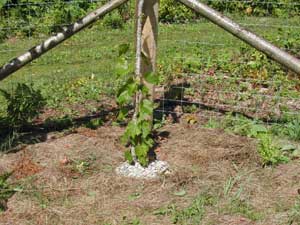 GETTING STARTED WITH
GRAPES is relatively easy due to the vine’s enthusiasm for growing. If you are
quite tired of the admonition that you put this plant or that in "your best
and most fertile soil" -- when the total amount of your thus designated
ground could be traversed by a large beetle in a matter of minutes -- you’ll
love the grape. It is one of the few crops that prefers less fertile land. Other
recommendations vary, but every source I’ve seen talks about the importance of
good drainage, particularly soil but air, too. Grapes don’t like sogg, so if
you have wetlands leave that area for the wildlife [who certainly need it more
than we do] and find drier ground for your grapes. Think well drained. The ideal
soil is gravelly, stony, coarse, heat retaining, with enough organic matter, but
not too much. But grapes can and do grow in a wide variety of soils, which is
good. Most of us have to make do with what we have. Our soil here is mostly
sandy loam or loamy sand. It suits the well-drained and not overly fertile
designation just fine. GETTING STARTED WITH
GRAPES is relatively easy due to the vine’s enthusiasm for growing. If you are
quite tired of the admonition that you put this plant or that in "your best
and most fertile soil" -- when the total amount of your thus designated
ground could be traversed by a large beetle in a matter of minutes -- you’ll
love the grape. It is one of the few crops that prefers less fertile land. Other
recommendations vary, but every source I’ve seen talks about the importance of
good drainage, particularly soil but air, too. Grapes don’t like sogg, so if
you have wetlands leave that area for the wildlife [who certainly need it more
than we do] and find drier ground for your grapes. Think well drained. The ideal
soil is gravelly, stony, coarse, heat retaining, with enough organic matter, but
not too much. But grapes can and do grow in a wide variety of soils, which is
good. Most of us have to make do with what we have. Our soil here is mostly
sandy loam or loamy sand. It suits the well-drained and not overly fertile
designation just fine.
The grape has other preferences, of
course. And a major one is for sunshine and heat. Not something we have a lot
of. But even if the U.P. doesn’t remotely resemble Italy or France or
California, we grow grapes. Across the upper Midwest there are a respectable
number of vineyards, producing wonderful and interesting wines. The grape is,
thankfully, amazingly adaptable.
Life is never black and white. I’d
like to be able to report that I followed all the rules and thus arrived with a
wonderful harvest of grapes via a nice neat orderly line. But twasn’t so.
Straight lines don’t seem to suit us. I suppose the fact that our new garden
fence ended up with ten sides, and our house has six, says something about how
we approach life, and our homestead.
My first grape planting (of one vine) was the result of a pretty
colored photo in a glossy catalogue and a naive belief in the descriptive hype.
Oh well, I’ve made worse mistakes. Hardy is relative. What is hardy in the
lake section of New York is not necessarily hardy in the colder areas of the
Upper Peninsula of Michigan. I knew we were on the edge though, and planted the
little Canadice vine on the east side of our house in a corner by the front
door, which I figured was the warmest spot we had. With little air circulation
and only part day sun, it didn’t thrive but it did grow. It made it through
several winters to produce an impressive crop of one little bunch of grapes. How
excitedly I watched those tiny globes grow and ripen. Every time I went out the
door I cheered them on. It was late, but they were beginning to color. One day,
after a short sojourn to the garden, I came back to the stark sight of stems
sans globes. In disbelief I demanded to know what had happened to my grapes! An
excited chittering nearby gave me my answer. Lesson number one -- no matter what
you think, they aren’t yours. You may get them first, but that has little to
do with rights of ownership.
The vine gave up the following winter.
It was years before I considered grapes again. But by then I had done a lot more
reading and studying.
This time I purchased cuttings from
viticulturist Lon J. Rombough of Oregon, choosing the recommended hardy
varieties Valiant and Edelweiss. With the accompanying clear directions I had no
trouble rooting and planting the cuttings, novice though I was. We had a well
prepared bed for the grapes along the east side of our garden, an open site with
both sun and air. The following year we installed a conventional post and two
wire trellis, anticipating the someday heavy vines.
The vines grew well, then died back
during the winter; the next year they grew, then died back; and again the
following year. It seemed we were not only on the edge of their acceptable
territory, we were over. And by many knowledgable accounts, these were some of
the hardiest grapes available. Sadly we removed the trellis, dug out the vines
and planted raspberries.
But many of the dug out root clumps
were so healthy and sturdy, I couldn’t just toss them in the compost pile. So
I chose the best looking and planted them along the west garden fence, about 30
feet from the woods. Though less sunny, this area was more protected from frosts
by the nearby forest. I didn’t expect to get fruit here, but thought they
might at least produce attractive vines. I dug in one by each fence post, ten
feet apart, and pretty much forgot about them. They didn’t get any special
care, though I would occasionally pull or cut back the grass and weeds and cut
down the wild brambles. If I had some extra mulch, I’d throw some around the
vines, and the trees added their own natural mulch.
They grew. And didn’t winterkill. I
became more interested, tying them up and cutting off some of the growth. They
grew sturdier, and I started studying books, trying to decipher the confusing
rules of pruning and training the vines. I stood resolutely in front of my vines
with books in hand -- but my vines seemed to bear little resemblance to the
drawings. Were we talking about the same plant? I persevered. I started to truly
care about those three growing vines. Did I dare hope for -- grapes --
someday?
Four years later they did it. They
barely made it, but mature they did -- 5# of the most beautiful grapes I’d
ever seen from three valiant Valiant grape vines. Then 13#, then 14#. I made
juice and jam and wine. We cut down a grove of nearby wild cherry trees that
were shading the vines. I was now serious about my grapes. I harvested 28# the
following year. I was learning, and they were responding. They weren’t the
sweet, dessert table grapes of commerce, but they tasted just fine to me. I was
soon working on developing the skill of popping several into my mouth, slipping
them out of their skins and spitting out the seeds without spitting out the
pulp. Homesteading is full of necessary new skills to learn.
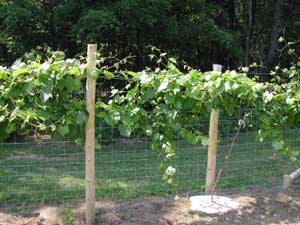 Lesson number 2 --
no rule is sacrosanct. It all depends. And your own experience is the best, and
maybe only true teacher. Good sun exposure is important for grape production and
these grapes would no doubt be sweeter and earlier maturing with more sun, but
in my case, the trade-off of less sun for the buffering affect of the woods was
a higher priority. Fewer grapes is better than no grapes.
Lesson number 2 --
no rule is sacrosanct. It all depends. And your own experience is the best, and
maybe only true teacher. Good sun exposure is important for grape production and
these grapes would no doubt be sweeter and earlier maturing with more sun, but
in my case, the trade-off of less sun for the buffering affect of the woods was
a higher priority. Fewer grapes is better than no grapes.
It’s a good recommendation to plant
young one year old plants or rooted cuttings. But I dug and moved yet another
three year old vine this past summer, a Kay Gray that wasn’t in an ideal spot,
and it settled in just fine. We’ll see this spring if it made it through the
winter without dieback in its new, more protected location. I hope so. Ideally
these plants will stay and produce where they are now for many, many years since
grapes vines can live a long time.
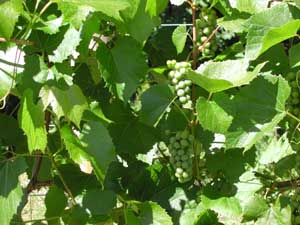 VARIETIES --
Probably the single most important thing you can do to better your chances for a
good harvest is to choose a variety that suits your climate and your growing
season. It’s fun to stretch the limits, but if you start with a grape that is
adapted to your area, then you can enjoy its fruit while experimenting with
other less sure varieties. Even wine makers consider the first, most important
element in making a good wine is the choice of an appropriate grape for the
area, climate, and soil. If the vine doesn’t thrive, neither will the wine. VARIETIES --
Probably the single most important thing you can do to better your chances for a
good harvest is to choose a variety that suits your climate and your growing
season. It’s fun to stretch the limits, but if you start with a grape that is
adapted to your area, then you can enjoy its fruit while experimenting with
other less sure varieties. Even wine makers consider the first, most important
element in making a good wine is the choice of an appropriate grape for the
area, climate, and soil. If the vine doesn’t thrive, neither will the wine.
Don’t depend on the glowing verbiage
of one glossy catalogue or a local nursery that just sells what is easily
available, whether appropriate to the area or not. Check around, ask around,
read catalogues, read books, compare notes, and be as knowledgeable as you can
in your choice. If I had chosen the common and oft sold Concord instead of the
shorter season Valiant, I would never have known that I could grow grapes in my
challenging environment.
A grape vine takes more commitment than
a strawberry plant or a tomato -- you won’t know for many years whether it
will mature fruit or what that fruit will taste like. But varieties,
descriptions, opinions, and suggestions abound, so it’s not the chancy
endeavor that it might seem. If I can find a grape to grow here, you can
probably find a grape to grow where you are. There are some 6000 named varieties
to choose from after all! And once you have a good, healthy, mature, producing
vine, you have the source for as many new cuttings as you probably care to
contemplate -- for expanding your own vineyard or sharing with others.
Of course, choosing a variety will
likely not be the main challenge. Once you get into grapes, limiting your
planting to a reasonable number will probably be more of a problem. It’s just
as well that my grape growing space is limited -- we really don’t need any
more grapes, though I keep looking. It is easy and relatively inexpensive to get
into grape growing, whether by buying bare rooted plants from a catalogue or dug
plants from a local nursery or cuttings via mail or friends. One plant may do,
but plan on a few more. Even grapes like company.
TO MULCH OR NOT
TO MULCH. Being an avid mulcher, I had to stop and think hard and long
before mulching my grapes. It’s important to understand the requirements of
the plant rather than the druthers of the gardener. Authors are across the board
when it comes to care of the vine after planting, and they are probably all
right -- for their climate and land. The grape wants heat to mature a good crop
and mulch tends to keep the soil cool. Yet one needs to keep competing
vegetation at bay, and mulch is an easy way to do this. Mulch also adds organic
matter and nutrients to the soil -- too much for the hard-scrabble grape? But in
areas of hard, cold winters, most vines need some protection if they are to live
or produce at all, and mulch can give that protection.
A stone or rock mulch is a possible
solution, and I’ve surrounded my vines, as I do my fruit trees, with a small
circle of gravel. I started placing flat rocks on the ground between vines. But during harvest
when I dropped a couple of precious bunches of grapes on the stone, with a
resulting messy splat, the stone mulch didn't look so good. And it wasn't easy
to pull the weeds from among the stones. Hay mulch was looking better.
Then I decided to expand my grape plot.
The Fedco catalog had enticed me with a King of the North description. Then a
Bluebell caught my eye the next year. The grape row made a 30 degree turn and
headed northeast. Still within the buffering affect of the woods, the new area
had fairly good sun exposure. But it also had good sod. So we mulched it heavily to clear
the ground. It will need that mulch cover for many years to keep the grass at
bay. I removed the flat stone from the older plot (we wanted it for building
stone anyway) and mulched that area, too.
For me, mulch makes sense. I decided
to simply rake it off the plot in the late spring, hoe the ground as needed, then
put mulch back on later. The soil
will be bare to soak up the sun in the early summer, mulched to keep weeds and
grass under control in late summer, and protected from the deep cold of winter when we don’t get
enough snow.
2008 ~ The
mulch worked fine, but it was a fair amount of work and hard to manage with such
a long expanse neighboring a good grass sod. So I tried a recommendation I had
read about (where??) to keep the ground bare in the early summer, then plant a
"sod" for winter protection. By planting oats in August I have a nice
growth to keep the ground temps moderate over winter, and keep the ground from
warming up too fast in the spring. When the weather settles and warms, I hoe in
the winterkilled oats and leave the ground bare to soak up the early summer
warmth, with maybe a hoeing or two to keep weeds down. Then in August, I plant
oats again. I like this system better, and the grapes don't seem to mind.
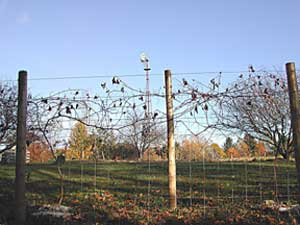 MANAGING THE VINE
is probably the most challenging aspect of growing grapes. In the north,
protecting the vine and the buds from frost and winter-kill is a necessary
consideration. One way is to train the vine so the canes can be taken down in
late fall and covered with mulch or dirt for winter protection from the cold. A
lot of work. MANAGING THE VINE
is probably the most challenging aspect of growing grapes. In the north,
protecting the vine and the buds from frost and winter-kill is a necessary
consideration. One way is to train the vine so the canes can be taken down in
late fall and covered with mulch or dirt for winter protection from the cold. A
lot of work.
Some recommend growing two trunks in case of an unusually cold winter where there
would be the better chance of at least one of the trunks surviving. I did this
for awhile but realized that it was probably more important in a commercial vineyard than
in the home garden, where being without a harvest for a few years while you
trained up a new trunk might be inconvenient, but not a financial disaster.
But while I had two trunks, I
experimented by laying down the canes of one trunk and covering them for the
winter while leaving the other trunk’s canes on the trellis. There was little
difference between bud survival or harvest between the two, so I thankfully
dispensed with this extra work. The Valiant was hardy enough in its new location
to survive just fine on the trellis. And I decided any other grape I grew would
have to be likewise as hardy. But this is certainly an option for getting a
tender vine through a cold winter.
There is still the problem of late
spring frosts and freezes damaging the buds and new growth, even if the vine
makes it through the winter. I prune my vines to the number of canes I want
before the buds start to swell in the spring, but leave the canes long. After
the buds swell, I prune them to final length. This way I can more easily see
which, if any, buds have been winterkilled. Plus the delayed pruning delays
growth and bud break of some of the buds, hopefully getting them past the
dangerous late frost period. Some cold years I end up covering the vines with
blankets spring, summer and fall to protect from unwelcome freezes -- an easy
way to expand my chances of a good harvest. They look rather like colorful
ghosts out for a dance, which helps lighten the "I can’t believe we’re
getting another freeze in July" angst. And those years (thankfully few)
that froze the buds in spite of all, the creative grape vines pushed out new
buds from deeper within. The fruit was later, but it was fruit! Plants really DO
know what they are doing, if we just let them do it.
 THERE ARE MANY
TRAINING SYSTEMS for the grape grower to choose from once the vine starts
growing; and they are explained well in most books on grape growing. There is no
one best method. I started with the fan system, thinking I would want to lay the
vines down for the winter, but ended up changing to a different, almost opposite
system. I decided that a better approach for me would be to have
permanent arms go out across the top wire with the fruiting and renewing canes
hanging down from there. The first buds on the canes were more prolific than the
buds farther out, and they would be better protected from the cold and frost if
they were toward the top of the fence rather than down by the ground where the
cold settles. Also, more buds and fruit clusters would be under cover when I
threw a protecting blanket over the vines. Later I found this is called the
Hudson River Umbrella System. THERE ARE MANY
TRAINING SYSTEMS for the grape grower to choose from once the vine starts
growing; and they are explained well in most books on grape growing. There is no
one best method. I started with the fan system, thinking I would want to lay the
vines down for the winter, but ended up changing to a different, almost opposite
system. I decided that a better approach for me would be to have
permanent arms go out across the top wire with the fruiting and renewing canes
hanging down from there. The first buds on the canes were more prolific than the
buds farther out, and they would be better protected from the cold and frost if
they were toward the top of the fence rather than down by the ground where the
cold settles. Also, more buds and fruit clusters would be under cover when I
threw a protecting blanket over the vines. Later I found this is called the
Hudson River Umbrella System.
It took some years to switch to
the new system, and rather confusing at pruning time, with some canes trained up and
some trained down and trying to decide who stays and who doesn’t. An
interesting challenge I had made for myself. But it worked and the vines
set fruit.
However, it was soon quite obvious that all of the varieties
I had really preferred to hang their canes UP, not nicely down as the
drawings in the books showed. I could tie them down to the bottom wire, of
course, and I did. Over and over and over again throughout the growing season.
Grape vines LOVE to grow. So, now that the vines were nicely changed over to the
new system, I decided to go with the flow (or the grow) and change once again.
Now the arms are going along the bottom wire, with the canes happily
growing up and over, or tied to, the upper wire. I often wonder what the vines
think of all this human fussing. In any event, they continue to do what they
most want to do, and do so wonderfully, in spite of me -- grow canes and
fruit.
Meantime, I decided to
move my grapes farther inside the fence. I started training a new trunk on a
stake in front of the established vine. We were due to replace our old fence
with a new one, so the timing was good to get the grapes off the fence and onto
their own wire trellis. Although the fence was convenient, the canes loved to
wind in and out of the wires which made pruning difficult -- and it was
already challenging enough. Then the deer discovered the vines, enjoying the
browse as they passed by. I really didn’t mind them pruning some of the shoots
that grew through the fence, but when they started nosing through the wire to
nibble on ripening fruit, it was time to move.
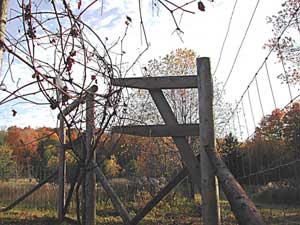
When planning the new fence, we put in
extra large posts in that area to handle the additional weight of the braces for
the grape trellis, making up our own design to fit the space and still make
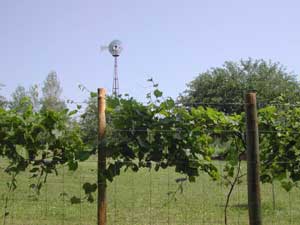
double use of the fence posts. We put up a two wire trellis, the top wire at
65", the bottom at 50". To bring the grapes in, yet still utilize the
posts, Steve made 2 x 4 braced offsets to hold the wire (see photo above). One end of
the long trellis wire is attached to the large gate post, the other to a
homemade wire tightener 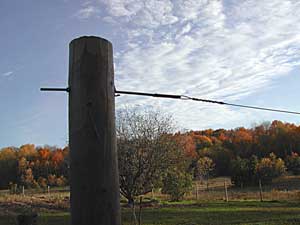 made of threaded rod, nuts, and washers that goes
through a separate post. In between are posts with holes drilled
through, the wire running through them.
made of threaded rod, nuts, and washers that goes
through a separate post. In between are posts with holes drilled
through, the wire running through them.
A few small posts with a top notch to
fit under the top wire and a side notch for the bottom wire were added later for
additional bracing when the vine was in full fruit. We used the high tensile
fencing wire we had purchased for the top wires of our new fence and it is
naturally somewhat stretchy. Most sources recommend #9 or #10 wire for
trellising.
PRUNING is
essential if you want a good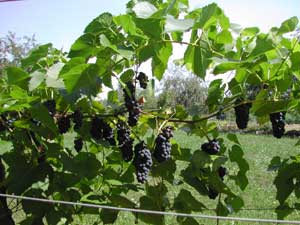 harvest of grapes from your vines. It can be a bit
traumatic, but enjoyable once you get the hang of it. The most important aspect
is not to be intimidated by the confusing and complicated formulas and rules set
forth in many books on grape growing -- nor by the tangle of growth and canes
and shoots presented to you by your vines. It may not be as easy as pulling
runners off strawberries, but home growers have been pruning grape vines for
eons. And what’s a homestead without challenges. harvest of grapes from your vines. It can be a bit
traumatic, but enjoyable once you get the hang of it. The most important aspect
is not to be intimidated by the confusing and complicated formulas and rules set
forth in many books on grape growing -- nor by the tangle of growth and canes
and shoots presented to you by your vines. It may not be as easy as pulling
runners off strawberries, but home growers have been pruning grape vines for
eons. And what’s a homestead without challenges.
The first year you don’t have to
worry much about it, except for researching and learning so you’ll be ready
when your vine is. You just want your plant to grow as well as it can and
develop a good root system. Some say to choose your trunk this first year,
others to leave it be until next. I let grow whatever will the first year, being
happy for each new leaf. If you haven’t put up your trellis yet, you’ll want
to now as the longer you wait, the harder it will be to work among the vines
without damaging them.
The most easily understood description
and graphics I’ve seen on pruning and training the grape vine is in "From
Vines to Wines" by Jeff Cox. Even if you have no interest in the wine
making end of it, this is a good book for its grape growing information.
"Growing Grapes in Minnesota", written by knowledgeable members of the
Minnesota Grape Growers Association, also does a good job. I’m sure there are
others, too, and the best is the one that is understandable to you. Glean from
all the sources you can because you will pick up different ideas from each. You’ll
learn most when you come face to face, or hand to hand, with your grape vine,
pruning shears at the ready. It helped me to draw out the system I wanted and
how the vine was to look after I had pruned it, including the number of buds to
leave. I still spend a lot of time standing there trying to sort out what is
what, and what isn’t. I like to take time pruning my grapes.
Every vine is different, so pat
formulas simply can’t apply. But if you give a reasonable amount of thought
and care to your pruning, you’ll have a healthy vine and a decent harvest, all
other things being cared for as well. Last year’s canes produce this year’s
grapes -- rather like a biennial plant. And you need to grow canes this year for
next year’s grapes. Everything else gets cut off. Then you trim back this year’s
fruiting canes to a certain number of buds, maybe 30 total for the entire vine,
spread over 3 to 6 canes. It’s as complicated, yet as easy, as that.
You’ll learn by observing your own
vines. If you have a lot of spindly growth the next year, you probably left too
many buds. If the growth is rampant, too few. Or you overfertilized. It isn’t
an exact science and is as open to interpretation as anything else in life.
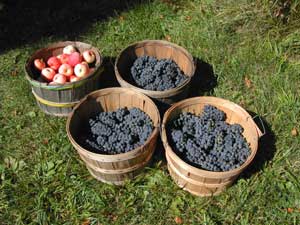 Before you know it, after all those
years of growing and pruning and training, the HARVEST arrives -- for you, for
friends, and probably a share for the birds, insects and animals. Some will
consider this simply the midpoint on the way to a fine bottle of wine. For
others, the beauty of the vines themselves are enough. I could happily spend
many hours drawing or painting the grape vine. But the ripe fruit is enticing,
and so beautiful. What to do with it is a whole ‘nother adventure (and
article). The options are many. Before you know it, after all those
years of growing and pruning and training, the HARVEST arrives -- for you, for
friends, and probably a share for the birds, insects and animals. Some will
consider this simply the midpoint on the way to a fine bottle of wine. For
others, the beauty of the vines themselves are enough. I could happily spend
many hours drawing or painting the grape vine. But the ripe fruit is enticing,
and so beautiful. What to do with it is a whole ‘nother adventure (and
article). The options are many.
So while you are struggling with the
pruning and wondering if those hard little balls will ever turn into soft edible
grapes, think of what lies ahead. When you taste your first sun ripened picked
fresh from the vine exquisitely bloomed peak-of-ripeness grape, whether sweet or
sour -- when it was your own sweat that contributed to this moment -- then you
will know there is hope, and all can indeed, be right with the world.
* * * * * * *
SOURCES:
 Minnesota Grape
Growers Association -- www.mngrapes.com. "Growing Grapes in
Minnesota", 67 pages, $8.50 from MGGA, 35680 Hwy 61 Blvd, Lake City MN
55041. Minnesota Grape
Growers Association -- www.mngrapes.com. "Growing Grapes in
Minnesota", 67 pages, $8.50 from MGGA, 35680 Hwy 61 Blvd, Lake City MN
55041.
Lon J. Rombough's
website -- www.bunchgrapes.com.
Fedco Trees, PO Box
520, Waterville, Maine 04903-0520 -- www.fedcoseeds.com.
* * * * * *
Copyright
2005-2008 by Susan Robishaw
[see
"Growing Berries
for Food and Fun" , published in 2016, for updates from my additional years
of experience growing grapes, as well as raspberries, blueberries, and
strawberries].
|




 .
.