* * * * *
2022
It's amazing to me to read back through these pages and realize how many years
I've been gardening, growing our food. How some things change, and others don't.
I still plant my own corn seed, enjoying laying out my plot, 4 rows, seeds 12"
apart. It grows well. I sometimes do 3 plantings, most often two. A few years
ago I skipped planting corn, and a few other crops, since we would be redoing
our house roofing - a major project - and I knew I wouldn't have much time when
harvest came around. It was fine as I had extra dried corn from the previous
year, though we did miss the fresh.
Many years ago I got tired of the temporary electric fence around the corn
routine; it was probably when our first cherries started producing (which
raccoons love as much if not more than corn!). So we put electric fence on our
regular fence all around the garden. In 2017, with an expanding orchard, we
extended the fence including the electric so now have about an acre
inside. That has worked very well -- as long as one remembers to turn the fencer
on! (LINK to Fence page in Orchard
section).
But the wildlife situation is interesting. In our early years we had no
raccoons. We had a fence to keep the deer out, but it was only about 5 ft tall.
It worked. Then the forests around us were clear-cut, sad for both wild and
tame. That was when the raccoon "problem" began, and we struggled with that for
decades. But woods change, the "forest" is now a fairly mature Red Pine
plantation. We still have deer, but it's been quite a few years since we've seen
a raccoon, and haven't turned the electric on for the last couple years. I know
it's a gamble, and I keep a close watch for any sign. And I know there are many
variables that cause the rise and fall of populations of anything. One of many
things that keeps the gardening life fresh and interesting!
* * * * *
2017
Beautiful Drying Day -- September 2, 2017 --
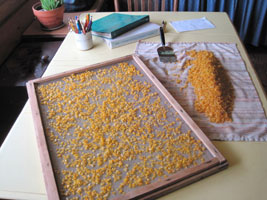 We've
had a real nice sweet corn crop this year and I've dried several good batches.
Today the last large harvest went in the dryer. There are still some ears out
there, mostly smalls and seconds, so we'll have a few more good meals and one
more dried batch. We love sweet corn fresh but the season is rather short so
most of my corn is preserved for later eating. And my favorite way to store it
is dried.
We've
had a real nice sweet corn crop this year and I've dried several good batches.
Today the last large harvest went in the dryer. There are still some ears out
there, mostly smalls and seconds, so we'll have a few more good meals and one
more dried batch. We love sweet corn fresh but the season is rather short so
most of my corn is preserved for later eating. And my favorite way to store it
is dried.
I harvest it as one does for fresh eating: husk and steam the ears (about 10
minutes), cut the kernels off the cob, then spread on the dryer screen and out
in the solar dryer it goes. This requires several good sunny days to get it
properly dried so it's sometimes a challenge to get it all coordinated between
ripeness, weather, and our schedule (will I be home at the right time). If
it gets a good drying day then it can wait inside on the holding racks for a day
or two before going back out. But there have been years when the weather just
didn't cooperate and I had to dry the harvest inside on the cookstove. It works
but takes a lot more attention to keep from burning it. But this year I've
managed to hit the right days at the right time and the jars of beautiful dried
kernels are multiplying, dried in our much appreciated solar food dryer.
The dried corn smells wonderful when you open the jar, and is easy to cook. Just
cover with water, soak a bit then simmer for a short time. It comes out very
near to fresh tasting! I also toss some in winter soups. But probably the way I
like it the most is to include a handful when cooking rice. It adds both flavor
and visual appeal.
* * * * *
2016
I realized I
hadn't added anything to this page in quite awhile. But in reading through what
has gone before there simply isn't much to add! I'm still growing the same sweet
corn mix, the same way, saving seed now and then when my supply gets low. The
seed lasts so well and so long that it isn't very often; the last save (2014)
was seven years after the previous and still germinating well. It gets better
every time though as I select once again for the plants and ears that grow best
in my garden.
It's been a
long time now since I've had stem borer problems and the crops have been good,
some better some less depending on the weather but always we have corn. This
year was a record warm, long season for us and the best ever harvest. My corn
may put up with the colder, shorter years but it obviously much prefers a little
more heat! And it got it this year. We ate well in season and had plenty to dry
for winter. It gets added to the luncheon salad rice as it cooks, and into
the many winter soups, adding both color, flavor, and nutrition. It is a fairly
easy and much
appreciated crop.
* * * * *
2005 -
2008
I've pretty much
settled on a good corn routine for my garden that's working well. Rake the mulch
off the corn plots early so the soil can warm and the birds can harvest any corn
eating insects they can find. Plant two seeds per spot the end of May, four rows
per 4' wide plot, 12" apart; then a second planting mid June. When the
plants are about 6" tall, thin to one plant every 12" (approx),
pulling plants that show signs of stem borers (indicated by an even row of
usually 4 squarish holes in leaves) and generally the weaker or less robust
looking of the two.
Don't mulch until soil
and weather warm (which coincides with when the fields are ready to cut for
hay). Be content with "ankle high by the 4th of July" -- appreciate
that these varieties in general have smallish stalks and whoever came up with
the "knee high by the 4th of July" maxim did not live the Upper
Midwest! (Though in the unusually hot summer of 2005, my corn was "thigh
high by ..." It was so amazing I went out often just to watch it grow.
Great harvest that year, too.)
If I'm going to save seed, I mark with clothespins the
earliest and best looking ears, at least 50, to leave to mature for seed. This
way, I don't have to stop and think about each ear before picking green. I just
have to resolve not to pick those beautiful ears marked for seed. It's worth it
in future crops.
Note to myself: Remember
to put the electric fence up around the corn BEFORE the first ears ripen, don't
wait for the raccoons to let me know when the first corn is at its peak (though
they are better at knowing that than I am). Eat as much fresh green corn as we
can when its ready, dry the rest, and enjoy, with great appreciation, it all.
Chop the stalks down in pieces with long handled loppers when the fruit has been
harvested, thereby making it easier to see what stalks still have ears. Plus the
stalks rot better and are easier to manage the following year (than when the
stalks are left whole).
What a great crop corn is. And I love the diversity in my
crop, both the sweet and the flour. It seems to enjoy itself, and we certainly
enjoy it.
* * * * *
2004
I again had a good amount of stem borer activity and damage in my
sweet corn,
and handled it the same as last year (Dipel and wood ashes). In addition, I
planted two seeds per spot and let them grow later than I usually do without
thinning. Quite often one had damage but not the other, so I pulled up the
damaged plants and composted them. This worked quite well and I ended up with
somewhat fewer plants but a decent crop. Next year I’m going to pull the mulch
off the plot when I plant then leave it bare for a time to give the birds a
better chance at the worms, putting the mulch back when the plants are up and
growing well.
The corn made it through the many frosts with surprisingly little damage,
though maturity of ears was widely variable, I assume because of the less than
ideal continual wet weather. We had many summer meals of corn and I dried an
adequate supply of green corn (which is never quite enough when winter comes!).
* * * * *
2003
This should have been a good year for the corn with all
that hot weather. I've been growing my own
cross of a mixture of short season, open pollinated, sweet corns so I have a lot of
diversity. And I continue to plant early, especially when I want the corn to
mature so I can save seed, as was my want this year.
Some
years it works, some not. This year a couple of late June frosts set them back
pretty good. Then in early July I started seeing a lot of damage by stem borers
-- a beautiful plant cut off or broken off at the base. And a great deal of
rough edged holes on leaves and stems. Another new experience -- wonderful.
I
researched as I could, without finding much encouragement for successfully
combating these guys at this late date. So I thought about it, sprayed the
plants with Dipel, put fresh wood ashes around each plant, and made sure I let
the birds know how much I appreciated all they did in the garden. I don’t do
much for them, except provide water, but they do so much for me! Particularly, the
wonderful little Chipping Sparrows.
Either
the timing was right, the weather was right, what I did was right, the birds had
some good feasts, or the borers decided to bore elsewhere. Anyway, I didn’t
have any more damage and ended up with a decent crop of corn, though the
maturity was more variable than usual.
We ate a
lot of fresh corn, dried a good amount of green corn, and harvested enough good
dry ears in the fall for seed. There were a lot of corn worms and I killed many
of them on the silks, keeping an eye out for them whenever walking by the corn.
I
planted half my corn in plots of 4 rows, the other half in plots with two rows
of corn and two of beans. The 4 row plots were somewhat better and easier to
manage. Since I almost always end up having to cover the beans because of late
frosts, having half the plot in corn didn’t work very well. I'll keep the two
separate in the future.
* * * * *
1999
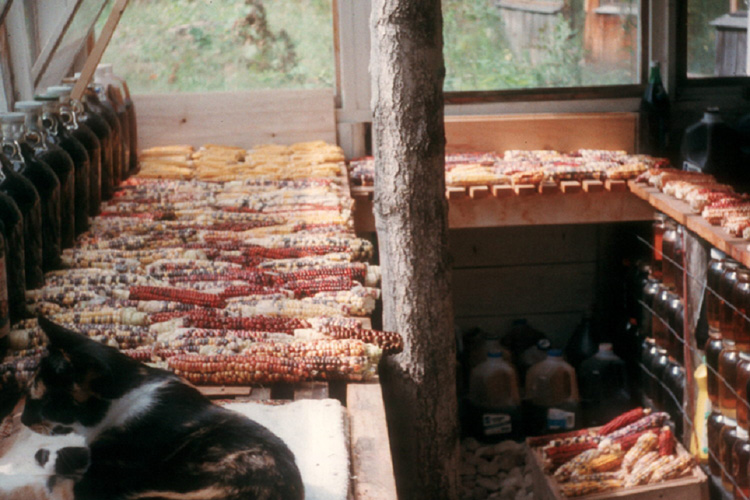 Normally I grow my own mixed variety of (mostly) flour corn, eating and
drying it green at the proper time, letting the rest mature and dry down for
grinding. But we’d had a number of good dry corn years, and I had plenty of
grinding corn. So I dug out all my old, leftover sweet corn seed and planted
that, harvesting all in the green stage for eating and drying. And it was a
great year. For the first time, we have plenty of dried green corn—and is that
nice! Just rehydrate, and you have the freshest tasting corn in the middle of
winter. No frozen or canned corn can compete.
Normally I grow my own mixed variety of (mostly) flour corn, eating and
drying it green at the proper time, letting the rest mature and dry down for
grinding. But we’d had a number of good dry corn years, and I had plenty of
grinding corn. So I dug out all my old, leftover sweet corn seed and planted
that, harvesting all in the green stage for eating and drying. And it was a
great year. For the first time, we have plenty of dried green corn—and is that
nice! Just rehydrate, and you have the freshest tasting corn in the middle of
winter. No frozen or canned corn can compete.
These were all open pollinated, old fashioned flavor, sweet corns—and some
very nice varieties, too. My favorite, and best, is Simonet, with Fisher’s
Earliest close behind. Double Standard and Ashworth are also good, Ashworth
being the earliest of the lot, Double Standard the latest. The diversity was nice
because it spread the eating and the harvest over a long time period.
I still like the green stage of my regular grinding corn (mostly flour
varieties) for eating and drying, but it was nice not to worry about which ears
to save for maturing for corn meal/flour and which to pick green. We
lost a few to a raccoon, but got the electric fence up in time to harvest most
ourselves.
* * * * *
1997
I suppose Nature gets pretty tired of us whining about it
being too cold or too hot, too wet or too dry, so she simply
hands us all of that in one season, and one can’t help but
wonder what she’ll do next year. The growing season of 1997
wasn’t the best, it wasn’t the worst, here in our low U.P. garden.
The corn was late so I didn’t get a dry corn crop, but I
managed to harvest, and dry, a good amount of green corn, in
spite of the raccoons getting past our electric fence. Dried
green corn is one of my favorite garden “preserves”.
You can use any kind of corn, sweet or field. When it is at the
fresh eating stage steam cook the ears about 10 minutes, just as
you would for eating, then cut off the kernels and dry,
preferably in a solar dryer. It takes only one or two good
sunny days to dry. In the winter throw a handful or so into your
dry bean dishes, or soups or stews, for some delicious eating.
* * * * *
* * * * * *
Copyright © Susan Robishaw




 .
.